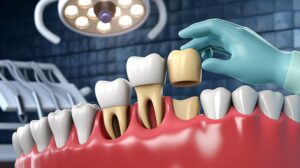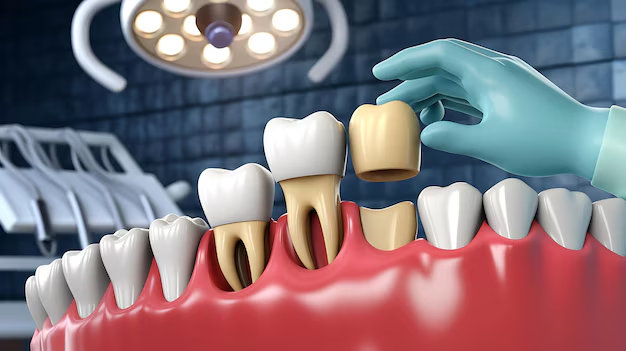
A dental crown has two jobs at once. It has to rebuild a tooth that decay, damage, or wear has weakened, and it has to hold up under years of biting force. The material you choose affects how the crown looks, how it ages at the gumline, how it treats the tooth opposite it, and what it costs. Porcelain and metal sit at opposite ends of that trade-off, and porcelain-fused-to-metal sits in between.
What a Dental Crown Is Meant to Do
A crown is placed over a tooth that has been weakened by decay, damage, or wear, restoring its shape and strength. Crowns are used on teeth with extensive decay or trauma, and they also reinforce other dental work such as implants and root canals. Once the decision to move forward with a crown is made, the material question becomes one of the most practical things to settle. Which type the dentist selects depends on a few factors, including the position of the tooth and the reason the crown is being applied in the first place.
Porcelain Crowns: Ceramic Strength With a Natural Look
Most crowns are made of porcelain, a ceramic material that is strong and closely resembles natural tooth enamel. Porcelain is valued for how naturally it blends with the surrounding teeth, which is why it shows up so often on front teeth and anywhere a smile line is visible. All-porcelain crowns offer similar strength and toughness as other types of dental crowns, and because there is no metal core, there is no chance of metal showing at the base of the crown.
That last point matters more than it sounds. A crown margin sits right at the gumline, and in a tooth-colored restoration there is simply nothing dark underneath to reveal itself later. Patients who have seen a gray shadow appear at the edge of an older crown tend to appreciate that detail.
The counterweight is fracture resistance. Metal’s strongest selling point in this comparison is that it is less likely to break or chip, which tells you where the ceramic option is more vulnerable. Porcelain that takes a hard, off-angle hit can chip, particularly on a back tooth that does the heavy chewing.
Metal Crowns: Tough, Practical, and Less Expensive
Metal dental crowns are less expensive than porcelain crowns and are less likely to break or chip. Metal is respected for its toughness, and that toughness is the whole argument for it. A metal crown tolerates heavy biting forces and does not fracture the way a ceramic surface can.
The obvious limitation is appearance. Metal does not mimic enamel, so it reads as metal in the mouth rather than as a natural tooth. For that reason, metal is most often considered for back teeth, where biting forces are heaviest and visibility is lowest.
Cost is the other part of the metal case. In a direct comparison, metal is the lower-priced category. Exact fees vary by practice, by the tooth being restored, and by what the tooth needs underneath the crown, so a written estimate from your own dentist is the only number worth planning around.
Porcelain-Fused-to-Metal Crowns: A Middle Path
Porcelain-fused-to-metal crowns, often shortened to PFM, place a layer of porcelain over a metal shell. The metal gives the crown its strength, and the porcelain gives it a tooth-colored surface. PFM crowns offer a strong bond with the underlying tooth structure and are more durable than all-porcelain crowns. They are also described as even stronger than ceramic, and they help seal the tooth to protect it from bacteria, fluids, and other decay-causing agents.
Historically, PFM crowns have been considered more durable than all-ceramic crowns because of the strong metal layer beneath the porcelain. That history is why they were the standard restoration for so many years and why they still appear in crown comparisons today.
The compromises are worth knowing up front. The metal base can eventually show at the gumline as a dark edge, which is exactly the problem all-porcelain avoids by having no metal at all. PFM and ceramic crowns also wear an opposing tooth more than a natural tooth would, a point covered in more detail below.

Zirconia and Other Crown Options
Comparison guides for porcelain and metal crowns also cover zirconia alongside the more traditional choices. If a practice offers zirconia or another ceramic formulation, ask how it differs for your specific tooth in three areas: appearance next to your other teeth, how it behaves against the opposing tooth, and how it handles the forces that particular tooth sees every day. Material names matter less than how the material fits the job.
Comparing Porcelain, Metal, and PFM at a Glance
The table below gathers the trade-offs that come up most often in crown comparisons. Use it as a starting point for the conversation with your dentist rather than as a final answer, since the right choice depends on the tooth and the reason it needs a crown.
| Factor | All-Porcelain | Metal | Porcelain-Fused-to-Metal |
|---|---|---|---|
| Appearance | Closely resembles natural tooth enamel | Does not blend with enamel; reads as metal | Tooth-colored surface over a metal base |
| Cost | Generally the higher-priced option | Less expensive than porcelain | Ask your dentist for a written estimate |
| Breaking and chipping | Ceramic can chip under hard, off-angle force | Less likely to break or chip | Porcelain layer over metal; more durable than all-porcelain |
| Metal show-through | No chance of metal showing at the base | Metal is the material | Metal base can show at the gumline |
| Durability notes | Similar strength and toughness to other crowns | Valued for toughness under heavy force | Strong bond to the tooth; historically more durable than all-ceramic |
| Wear on the opposing tooth | Ceramic wears the opposing tooth more than natural enamel does | Not addressed in the sources reviewed here | Wears the opposing tooth more than natural enamel does |
How Crowns Affect the Tooth Opposite Them
Material choice is not only about the crowned tooth. Porcelain-to-metal crowns and ceramic crowns will wear an opposing tooth more than a natural tooth would, grinding away more of the opposing enamel over time. That is a long-term consideration, and it is a good reason to bring up any grinding or clenching habit before the crown is made. A patient who grinds puts more cycles of force through both the crown and whatever it meets, so the wear question deserves a real answer rather than a footnote.
How the Crown Material Gets Chosen in Bedford, MA
There is no single best crown material, only a best fit. The factors that carry the most weight are the position of the tooth in the mouth, the reason the crown is needed, how much force that tooth absorbs, how visible the tooth is when you smile, how much tooth structure remains, and your own priorities on cost and appearance.
A molar at the back of the mouth and a front tooth next to a visible incisor are two very different assignments. A tooth that has been through root canal treatment or that anchors an implant has its own set of demands. Patients in Bedford and the surrounding towns of Lexington, Burlington, Billerica, and Reading tend to ask the same practical question first: will anyone be able to tell? From there, the conversation usually turns to durability and cost.
Our approach in the office is to make that conversation concrete instead of abstract. Digital scanning and imaging let us show you the tooth on screen, walk through what the crown has to do, and compare the realistic material options for that specific spot in your mouth. You should leave the appointment knowing why one option fits better than another, not just which one your dentist prefers.
Caring for a Crown, Whatever It Is Made Of
Maintenance does not change much from one material to the next. What keeps a crown healthy is what keeps the tooth underneath it healthy.
- Brush twice a day and clean thoroughly around the crown margin, where the restoration meets the gum.
- Floss or use the interdental cleaning method your hygienist recommends, since the edge of a crown is where plaque tends to collect.
- Keep your regular hygiene visits so the margin, the gum tissue, and the bite can be checked before small issues become expensive ones.
- Avoid habits that put sudden heavy load on a crown, such as chewing ice or hard objects.
- Report any new sensitivity, a catching feeling when you bite, or a dark line appearing at the gumline. Each of those has an explanation and usually a straightforward fix if it is caught early.
Frequently Asked Questions
Should I get a metal or porcelain crown?
It depends on the tooth. Porcelain is valued for how naturally it blends with surrounding teeth and for having no metal that can show at the base. Metal is less expensive and less likely to break or chip. For a highly visible front tooth, appearance usually leads. For a back molar under heavy biting force, toughness and cost often carry more weight.
Is a metal crown cheaper than a porcelain crown?
Yes. Metal dental crowns are less expensive than porcelain crowns. Specific fees vary by practice and by the tooth being restored, and the cost of the crown itself is only part of the total if other treatment is needed underneath. Ask your dentist for a written estimate so you can compare real numbers rather than general categories.
Do dentists still use metal crowns?
Metal crowns remain part of the standard set of options, and crown comparisons in Massachusetts practices routinely include them. Their toughness and lower cost keep them relevant, particularly for back teeth where they are least visible. Many patients still choose all-porcelain or porcelain-fused-to-metal for a more natural appearance, so the material question is settled case by case.
What are the downsides of porcelain-fused-to-metal crowns?
The main one is the metal base showing at the gumline as a dark edge, which all-porcelain crowns avoid entirely. Porcelain-fused-to-metal and ceramic crowns also wear an opposing tooth more than a natural tooth would, grinding away more opposing enamel over time. On the positive side, they bond strongly to the tooth and are more durable than all-porcelain crowns.
Will a crown damage the tooth it bites against?
Porcelain-to-metal and ceramic crowns wear an opposing tooth more than a natural tooth would, so some extra wear on the tooth opposite is expected over time. This is one more reason to mention grinding or clenching before the crown is made. Your dentist can assess your bite and discuss whether that changes the material recommendation for your case.